Cartilage Restoration
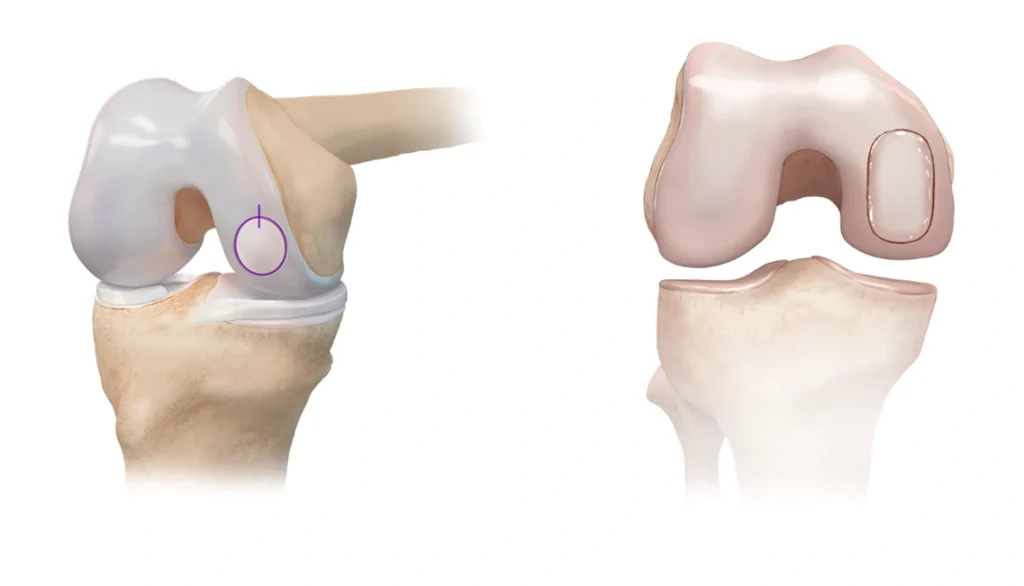
Cartilage restoration procedures are designed to treat focal areas of cartilage damage in the joint. Because cartilage has limited ability to heal on its own, these techniques aim to repair or replace damaged areas to restore a smoother joint surface. The goal is to reduce pain, improve function, and delay or prevent the progression of arthritis or the need for joint replacement. See more here.
MACI (Matrix-Induced Autologous Chondrocyte Implantation)
MACI is a two-stage procedure in which a small sample of a patient’s cartilage cells is first harvested and then grown in a laboratory. These cells are later implanted into the damaged area using a specialized scaffold that helps them grow and form new cartilage. This technique is used for certain cartilage defects and aims to restore durable, healthy cartilage over time.
Osteochondral Autograft (OATS)
In an OATS procedure, healthy cartilage and underlying bone are taken from a non-weight-bearing area of the patient’s own joint and transferred to the damaged area. This allows the surgeon to replace damaged cartilage with native, living cartilage. It is typically used for smaller cartilage defects and helps restore a smooth, functional joint surface.
Osteochondral Allograft (OCA)
OCA involves transplanting cartilage and bone from a donor to replace damaged areas of the joint. This option is often used for larger cartilage defects or when previous treatments have failed. The goal is to restore joint structure and function while preserving the natural joint and delaying the need for joint replacement.
Cartilage Restoration
Cartilage restoration procedures are designed to treat focal areas of cartilage damage in the joint. Because cartilage has limited ability to heal on its own, these techniques aim to repair or replace damaged areas to restore a smoother joint surface. The goal is to reduce pain, improve function, and delay or prevent the progression of arthritis or the need for joint replacement.
MACI (Matrix-Induced Autologous Chondrocyte Implantation)
MACI is a two-stage procedure in which a small sample of a patient’s cartilage cells is first harvested and then grown in a laboratory. These cells are later implanted into the damaged area using a specialized scaffold that helps them grow and form new cartilage. This technique is used for certain cartilage defects and aims to restore durable, healthy cartilage over time.
Osteochondral Autograft (OATS)
In an OATS procedure, healthy cartilage and underlying bone are taken from a non-weight-bearing area of the patient’s own joint and transferred to the damaged area. This allows the surgeon to replace damaged cartilage with native, living cartilage. It is typically used for smaller cartilage defects and helps restore a smooth, functional joint surface.
Osteochondral Allograft (OCA)
OCA involves transplanting cartilage and bone from a donor to replace damaged areas of the joint. This option is often used for larger cartilage defects or when previous treatments have failed. The goal is to restore joint structure and function while preserving the natural joint and delaying the need for joint replacement.